
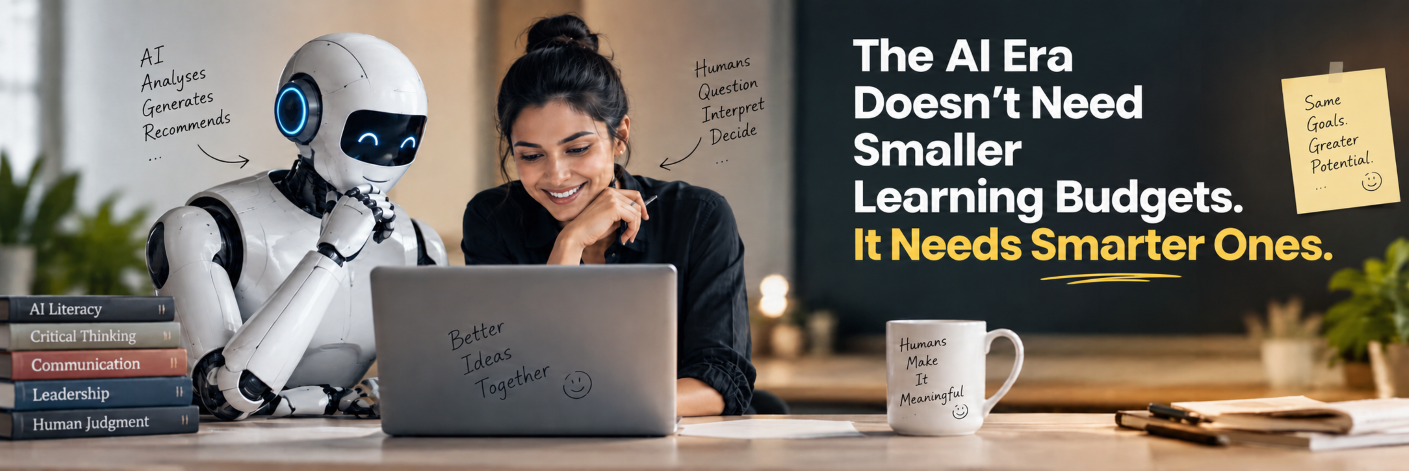
Image generated using AI.
Every technological revolution arrives with a familiar prediction: “Training won’t be needed anymore.” We heard it when computers entered offices, when Google put knowledge in everyone’s pocket and again when online learning became mainstream.
Yet here we are.
The AI era is no different. If anything, it has made learning more important than ever.
According to the World Economic Forum’s Future of Jobs Report 2025, 39% of today’s core workplace skills are expected to change by 2030. That’s not a reason to reduce learning budgets. It’s a reason to redesign them.
The smartest organizations have already figured this out.
Retail giant Walmart has invested over US$1 billion in employee learning while expanding AI capabilities across the business. DBS Bank has trained its entire workforce in AI fundamentals—not because everyone needs to become a data scientist, but because everyone needs to understand how AI is changing work. Even IKEA has used AI as an opportunity to reskill employees into higher-value customer-facing roles rather than simply automate routine work.
Somewhere along the way, many organizations assumed that if AI could answer questions, employees no longer needed to learn.
That’s a bit like buying a piano and assuming everyone in the house can now play Mozart.
AI has certainly become the fastest colleague in the room. It drafts reports before you’ve finished your coffee, builds presentations in minutes and somehow manages to sound remarkably confident about almost everything.
Including the things it occasionally gets spectacularly wrong.
This is exactly why Human-in-the-Loop has become one of the most important principles in AI adoption. AI can analyse, recommend and generate. Humans must still question, interpret and decide.
Ironically, many organizations are investing heavily in smarter AI while forgetting to invest in smarter humans.
If AI drafts the proposal, people still need the judgment to know whether it should be sent.
If AI recommends the best candidate, leaders still need empathy and ethics to make the hiring decision.
If AI predicts the next business opportunity, executives still need strategic thinking to decide whether it’s the right one.
AI doesn’t reduce the need for behavioural capability.
It raises the standard for it.
Critical thinking, communication, leadership, influence, collaboration and ethical decision-making are no longer “soft skills.” They are the skills that determine whether AI becomes a multiplier—or a very expensive mistake.
At Athiya, this is exactly why we’ve reimagined many of our learning journeys. AI literacy is no longer taught in isolation. It is woven together with behavioural capability, practical application and responsible AI adoption because successful transformation isn’t just about teaching people how to use AI.
It’s about preparing them to work confidently alongside it.
Perhaps the biggest misconception of the AI era is that technology will reduce the need for human development.
The opposite is happening.
The smarter AI becomes, the smarter humans need to become.